How Does Deepfake Work? A Simple Guide to Deepfake Technology
How Does Deepfake Work? Understanding Deepfake Technology
Deepfake technology has become one of the most talked-about applications of artificial intelligence. You may have seen videos where a person’s face appears to belong to someone else or heard an AI-generated voice that sounds surprisingly real. This raises an interesting question: how does deepfake work?
Behind these realistic results are technologies such as artificial intelligence (AI), machine learning, and deep learning. These systems can study large amounts of visual or audio data and then use what they learn to create or modify digital content.
What Is a Deepfake?
A deepfake is a type of synthetic media created or modified with AI. The term comes from “deep learning,” a branch of machine learning that helps computers recognize patterns and learn from large datasets.
Deepfake technology can be used for face swapping, realistic AI-generated videos, voice cloning, and other forms of digital manipulation. It has useful applications in movies, entertainment, education, and content creation. At the same time, it can be misused to create misleading or completely fake content.
How Does Deepfake Work?
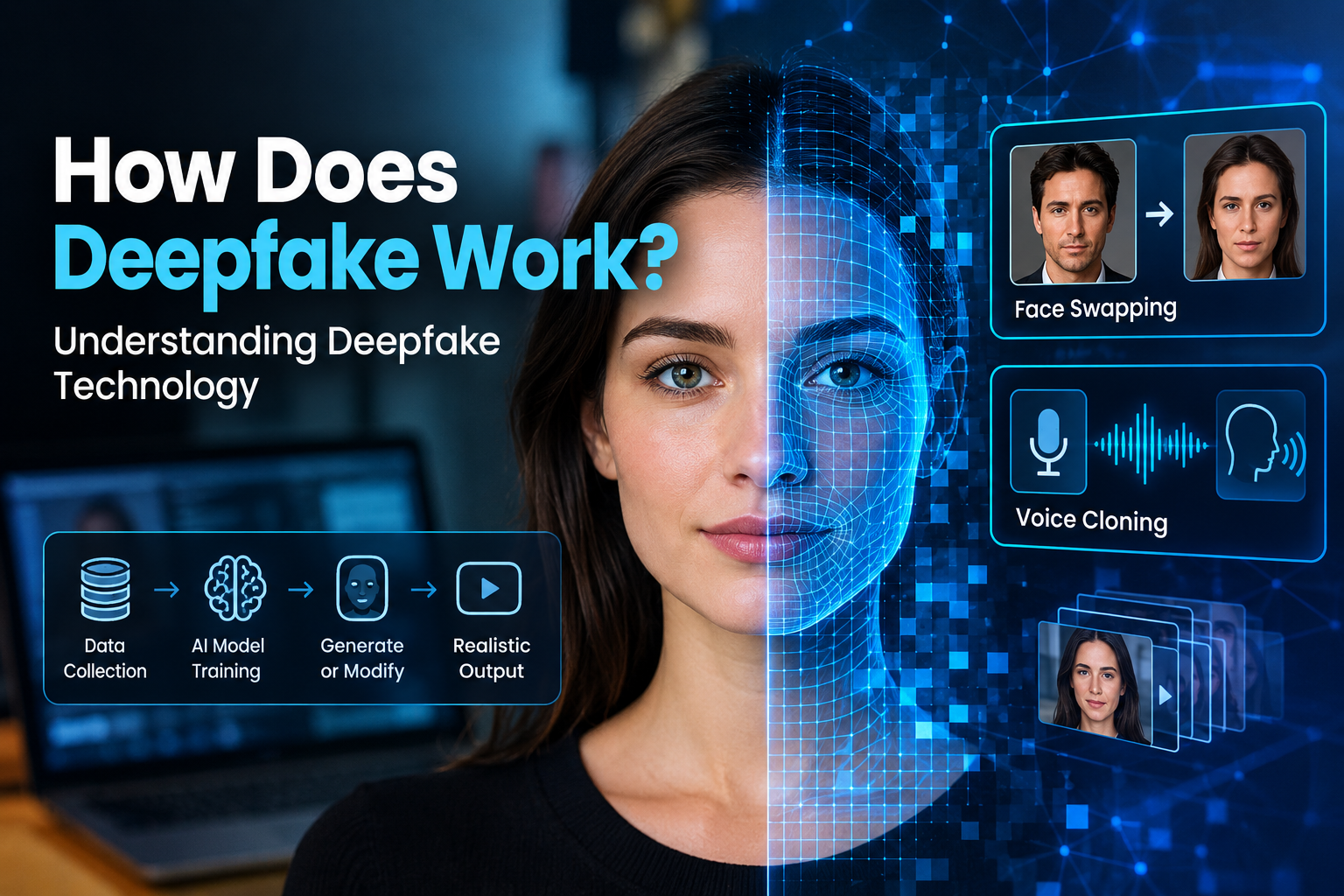
So, how does deepfake work behind the scenes? It generally starts with collecting a large amount of data. For example, an AI model designed for face manipulation may be trained using many images and videos of a person’s face.
The system studies different facial expressions, angles, movements, and lighting conditions. During this training process, the deep learning model gradually learns the visual patterns that make the person’s face recognizable.
Once the model has learned enough information, it can generate or modify new content. In a face-swapping video, for example, AI can map one person’s facial features onto another person’s face while trying to preserve natural expressions, movements, and lighting.
Some older and well-known deepfake systems rely on Generative Adversarial Networks (GANs). A GAN uses two neural networks: one creates synthetic content, while the other checks how realistic that content appears. By repeatedly improving through this process, the generated media can become increasingly convincing.
Modern AI systems can also use other advanced techniques, so not every deepfake today is created with GANs.
How Does Deepfake Voice Technology Work?
Deepfake technology is not limited to faces and videos. AI can also be used for voice cloning.
A voice cloning system can analyze recordings of a person’s speech to learn characteristics such as pronunciation, tone, rhythm, and speaking style. After training, the system can generate new speech that sounds similar to the original voice.
AI voice technology has useful applications in filmmaking, dubbing, accessibility, virtual assistants, and content creation. However, cloned voices can also be misused for impersonation and scams.
Why Are Deepfakes Important?
Deepfakes have both positive and negative sides. Filmmakers can use them to create visual effects, while creators can use AI-generated media for entertainment and storytelling.
The risks are equally important. Deepfakes can be used for misinformation, identity manipulation, fake news, impersonation, and online scams. Because of this, deepfake detection is becoming an increasingly important part of digital safety.
Final Thoughts
Understanding how deepfake works gives us a better idea of both the possibilities and risks of AI-generated media. As AI technology continues to develop, deepfakes may become even more difficult to distinguish from real content.
The best way to stay safe is to think critically about what you see online, check information from trustworthy sources, and avoid sharing suspicious content without verifying it first.
Share this content:













1 comment