Best Power Bank for Travel in 2026: Buying Guide
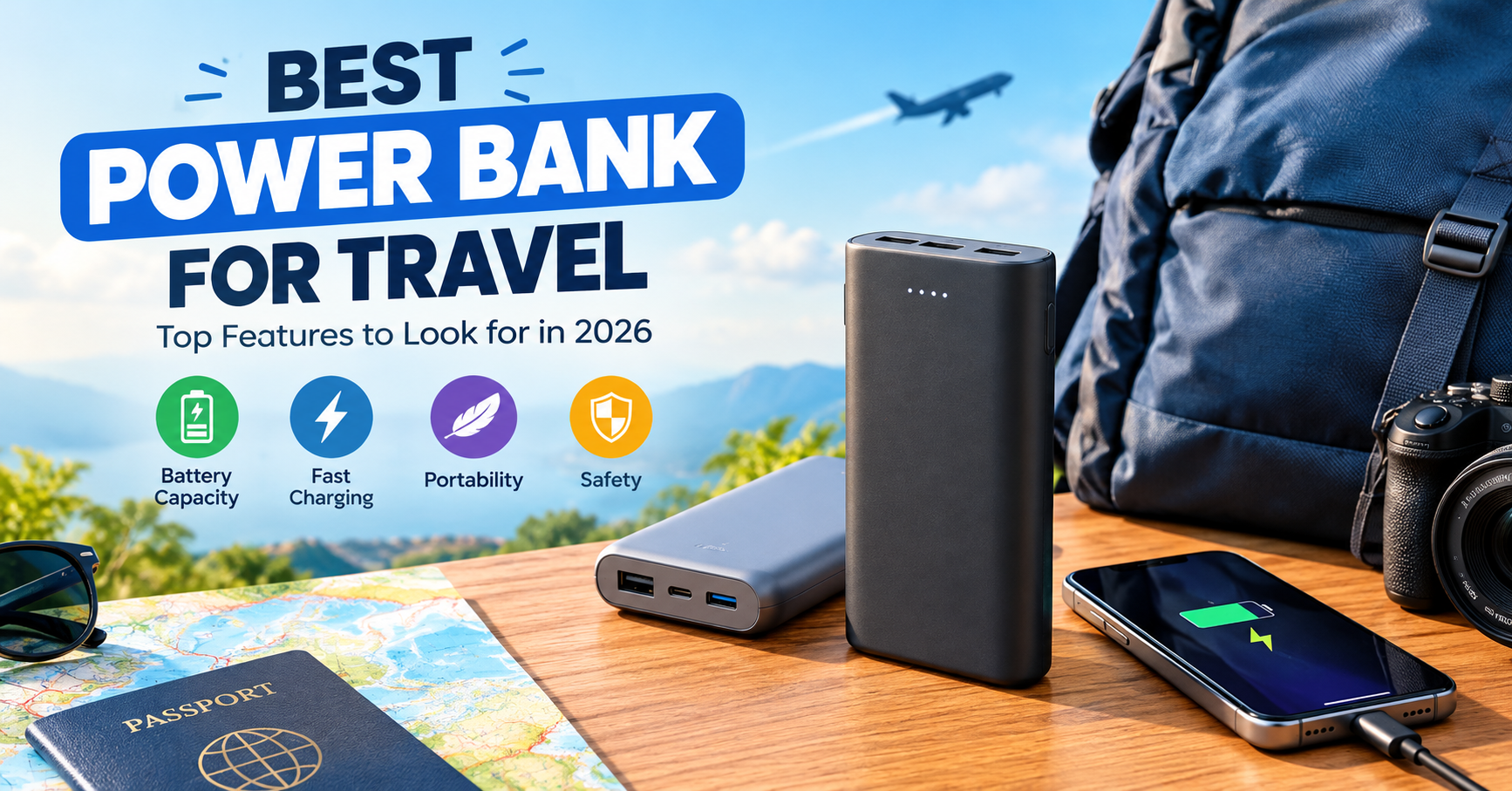
Best Power Bank for Travel: Top Features to Look for in 2026
Keeping your devices charged while traveling can make your journey much easier. From using Google Maps to capturing photos and booking tickets, your smartphone plays an important role when you’re on the go. But what happens when the battery runs low and there’s no power outlet nearby? That’s where the best power bank for travel comes in handy. In this guide, we’ll cover battery capacity, fast charging, portability, and safety to help you find the right power bank for your next adventure in 2026.
Why Do You Need a Power Bank for Travel?
Travel often means spending hours away from a power outlet. You might use your phone to navigate unfamiliar streets, take pictures, book hotels, check flight updates, or watch videos during a long journey. All these activities can drain your battery faster than usual.
A portable power bank gives you an extra source of power whenever you need it. It is useful for road trips, flights, train journeys, camping, and everyday commuting. Instead of searching for a charging socket, you can keep your essential devices powered up while you are on the move.
1. Choose the Right Battery Capacity for a Travel Power Bank
Battery capacity is one of the first things to check when shopping for a travel power bank. It is measured in milliampere-hours (mAh), and a higher number generally means more stored energy.
Here is a simple guide to help you choose:
- 5,000mAh: Best for emergency charging and short outings.
- 10,000mAh: A convenient option for everyday use and short trips.
- 20,000mAh: Suitable for longer journeys and multiple smartphone recharges.
- 25,000mAh or more: Useful when you need extra power for several compatible devices, subject to airline restrictions.
For most travelers, a 10,000mAh or 20,000mAh power bank offers a good balance between capacity and portability. Keep in mind that the actual amount of power delivered to your phone will be lower than the advertised capacity because of energy conversion losses.
2. Look for Fast Charging Support
Nobody wants to wait hours for a phone to charge while traveling. That is why fast charging is an important feature to consider.
Look for a power bank that supports USB-C Power Delivery (PD) or another charging standard compatible with your device. A 20W model can work well for many smartphones, while a 30W or higher model may be more useful for compatible tablets and some laptops.
However, buying a powerful charger does not automatically mean your device will charge at its maximum speed. Your phone, cable, and power bank must support compatible charging specifications.
3. Consider Size and Weight of Your Travel Power Bank
A power bank should make traveling easier, not add unnecessary weight to your bag. Although larger models usually provide more capacity, they can be less convenient to carry around all day.
If you prefer traveling light, a compact 10,000mAh model may be enough. For longer trips, a 20,000mAh power bank can provide more backup power without requiring you to carry a separate charger for every device.
Think about how often you will use it and how much space you have in your backpack before making a decision.
4. Check the Ports and Compatibility
Before purchasing a power bank, check which charging ports it offers. USB-C is especially useful for modern smartphones, tablets, and other electronic devices, while USB-A can still be helpful for older accessories.
If you carry multiple devices, consider a model that supports charging more than one device at a time. Also, check the output power available when several ports are being used together, as the charging speed may decrease.
5. Understand Airline Safety Rules
Planning to take your power bank on a flight? Check your airline’s rules before packing it.
Power banks generally need to be carried in cabin baggage rather than checked luggage. Many airlines allow batteries rated up to 100Wh without special approval, while larger batteries may require permission or face additional restrictions.
Airline policies can change, so confirm the current requirements before departure. If the capacity is listed only in mAh, check the manufacturer’s watt-hour (Wh) rating or calculate it using the battery’s voltage.
6. Choose a Safe and Reliable Brand
Price is important, but safety should come first. Choose a power bank from a reputable manufacturer and look for clear capacity information, built-in safety protections, and a reliable warranty.
It is also worth checking customer reviews and the manufacturer’s official specifications before buying. Be cautious of unusually cheap products that promise extremely high capacity without credible supporting information.
Conclusion
The best power bank for travel depends on how you travel and which devices you need to charge. A compact 10,000mAh model is a practical choice for short journeys, while a 20,000mAh power bank may be better for longer trips and heavier use.
Before buying, compare battery capacity, fast charging support, size, available ports, and safety features. If you are flying, remember to check your airline’s battery restrictions as well.
With the right power bank in your bag, you can spend less time worrying about battery life and more time enjoying your journey.
Share this content:








1 comment