AI in Science: How AI Is Transforming Scientific Research
AI in Science: How Artificial Intelligence Is Changing Scientific Research
Artificial Intelligence (AI) is becoming an increasingly useful tool in scientific research. Scientists are using AI to analyze large amounts of data, find patterns, test ideas, and solve problems that can be difficult to handle manually. From studying diseases and discovering potential medicines to understanding space and climate change, AI in science is opening new possibilities for researchers around the world.
What Is AI in Science?
AI in science means using artificial intelligence technologies to support scientific research and experiments. These technologies include machine learning, deep learning, and other data-analysis methods.
Scientists often have to work with huge datasets. An AI system can examine this information much faster than a person and may find patterns that are easy to miss. However, AI does not replace scientific thinking. Researchers still need to understand the results, test them, and decide whether the findings are reliable.
How Is Artificial Intelligence Used in Scientific Research?
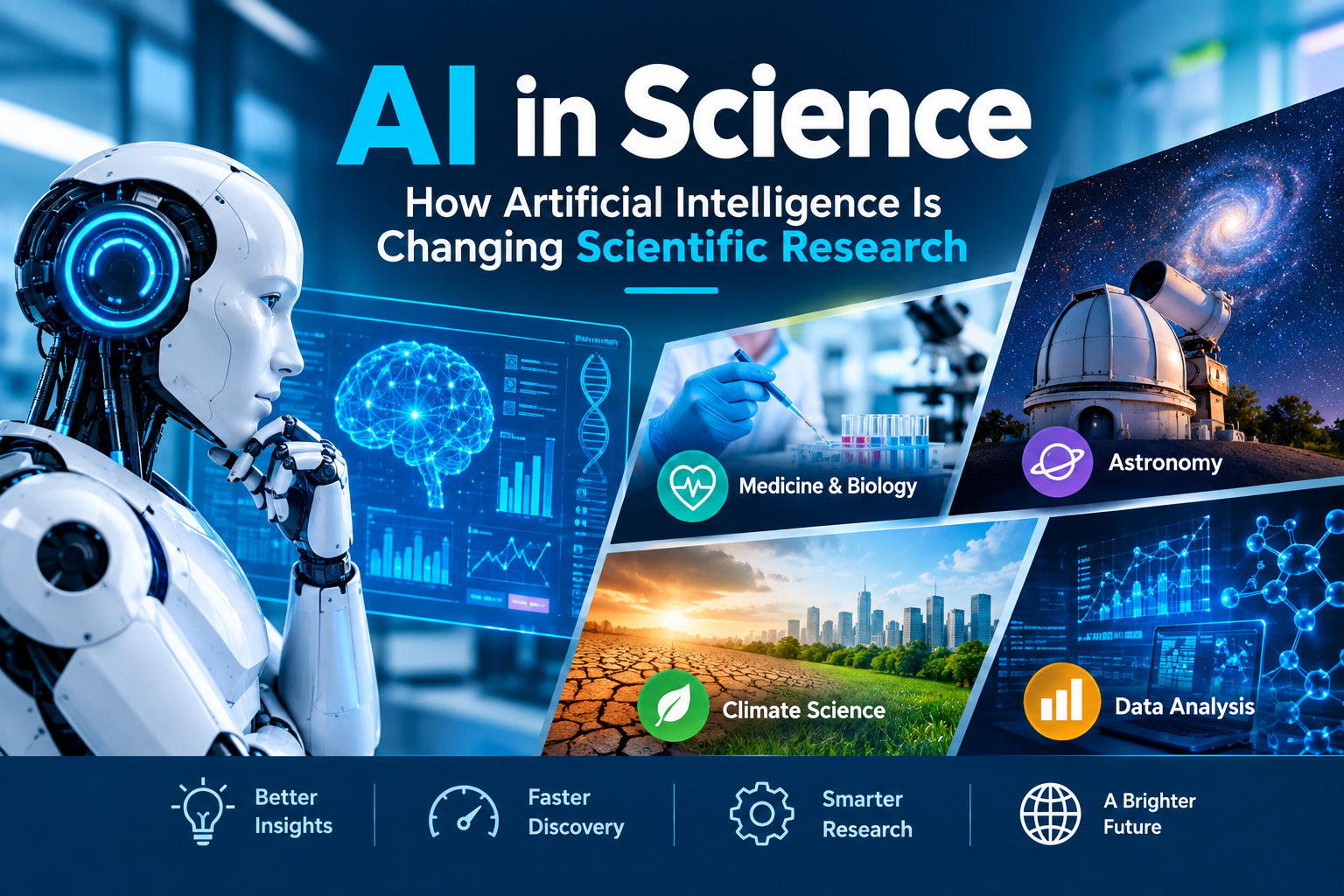
AI is already being used in several scientific fields. In biology and medicine, researchers use machine learning to study genetic data, investigate diseases, and search for possible drug candidates. AI can also help analyze medical images and highlight patterns that researchers may want to examine more closely.
In astronomy, scientists receive enormous amounts of information from telescopes and space missions. AI can help sort through this data and identify objects such as stars and galaxies. This can save researchers considerable time when working with large astronomical datasets.
AI is also useful in climate science. Researchers can analyze weather and environmental data with machine learning models to better understand climate patterns and improve certain types of predictions.
Key Benefits of Artificial Intelligence for Researchers
One of the biggest advantages of AI is its ability to handle large amounts of information quickly. A scientific study can generate thousands or even millions of individual data points, which can take a long time to analyze manually.
AI can also take care of repetitive tasks. This allows researchers to spend more time designing experiments, studying results, and developing new research questions.
Another useful application is scientific simulation. AI models can help researchers explore different possibilities and understand complex systems without having to test every possible situation in the real world.
Challenges of Using AI for Scientific Research
AI also comes with challenges. The quality of an AI system depends heavily on the data it receives. If the data is incomplete, inaccurate, or biased, the results may also be unreliable.
For this reason, scientists need to carefully check AI-generated results. A prediction made by an AI model is not automatically a scientific fact. Experiments, human expertise, peer review, and independent verification are still essential.
The Future of Artificial Intelligence in Research
The role of AI in science is likely to grow as artificial intelligence technology continues to improve. Researchers may use AI to work with larger datasets, explore complicated scientific questions, and speed up parts of the research process.
Frequently Asked Questions About AI in Science
1. What is AI in science?
AI in science is the use of artificial intelligence technologies such as machine learning and deep learning to support scientific research, data analysis, simulations, and discovery.
2. How is AI helping scientists?
AI can help scientists analyze large datasets, identify patterns, automate repetitive tasks, make predictions, and explore complex scientific problems.
3. What fields of science use AI?
AI is used in many fields, including medicine, biology, astronomy, climate science, chemistry, physics, and environmental research.
4. Can AI replace scientists?
AI is not a complete replacement for scientists. Researchers are still needed to design experiments, interpret results, verify findings, and make scientific decisions.
5. What are the challenges of AI in science?
Major challenges include data quality, potential bias, unreliable predictions, difficulty interpreting some AI models, and the need for independent scientific verification.
6.What is the future of AI in science?
AI may become an increasingly important research tool, helping scientists process larger datasets, run simulations, identify patterns, and investigate complex scientific questions.
AI should not be viewed as a replacement for scientists. Instead, it is better understood as a powerful research tool. When human knowledge and creativity are combined with AI’s ability to process data, they can help scientists explore new ideas and make progress across many areas of science.
Share this content: