Best AI Tools for Bloggers in 2026
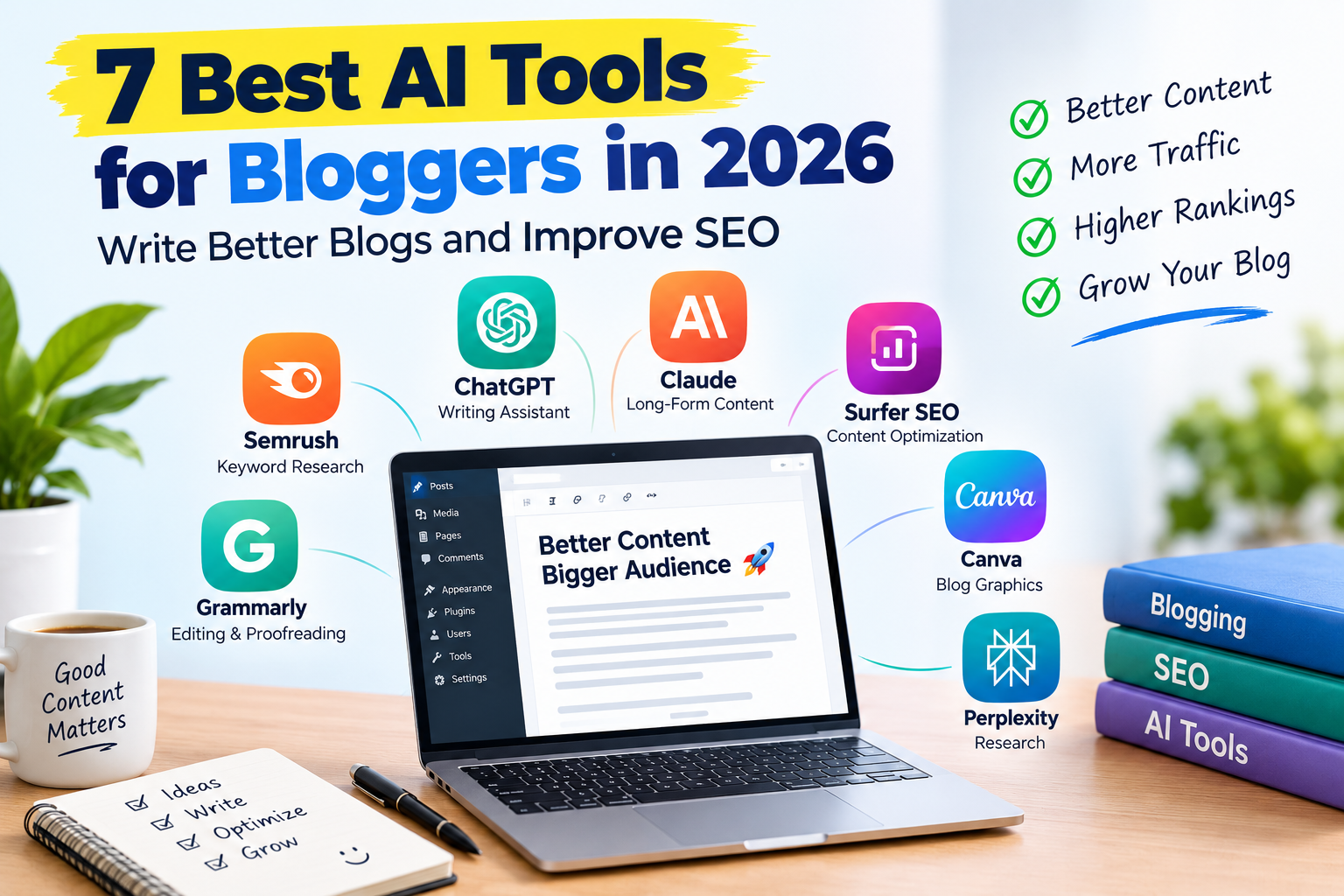
Best AI Tools for Bloggers in 2026 to Create Better Content and Boost SEO
Running a blog takes time and effort. From finding the right topics to writing articles and optimizing them for search engines, bloggers have a lot to manage. Fortunately, AI tools can make many of these tasks easier. The best AI tools for bloggers can help you brainstorm ideas, improve your writing, research keywords, and create eye-catching blog images without spending hours on every task.
But not every AI tool serves the same purpose. Some are better for writing, while others focus on SEO, research, or editing. In this guide, we’ll look at seven AI tools that can help bloggers create useful content and manage their websites more efficiently in 2026.
7 Ai tools for bloggers
1. ChatGPT – Best for Blog Writing
Coming up with fresh blog ideas isn’t always easy, especially when you publish content regularly. ChatGPT can help you brainstorm topics, build article outlines, write introductions, and organize your thoughts before you start writing.
It can also help you improve existing drafts, create FAQs, and write meta descriptions. For bloggers covering AI and technology, it’s particularly useful for explaining complicated subjects in simple language.
However, it’s important to review the output and add your own experience before publishing.
Best for: Blog ideas, article outlines, writing assistance, and content editing.
2. Claude – Best for Long-Form Articles
Claude is another useful AI assistant for bloggers who regularly publish detailed guides and informative articles. It can help organize complex information, rewrite confusing paragraphs, and improve the flow of a draft.
If your article feels repetitive or difficult to follow, Claude can suggest ways to make it clearer. You can also use it to summarize research materials and develop more structured explanations.
As with any AI writing assistant, check important facts and make sure the final article reflects your own perspective.
Best for: Long-form content, detailed guides, and rewriting drafts.
3. Surfer SEO – Best for On-Page SEO
Writing a good article is only part of blogging. You also need to make sure your content addresses what people are searching for. Surfer SEO helps bloggers evaluate their content and identify opportunities to improve on-page SEO.
Depending on the features available in your plan, you can use it to review content structure, discover related terms, and compare your draft with competing pages.
Rather than adding keywords everywhere, focus on answering the reader’s question thoroughly and naturally.
Best for: Content optimization, on-page SEO, and topical coverage.
4. Semrush – Best for Keyword Research
Choosing the right keyword can make a real difference to your content strategy. Semrush helps bloggers discover search terms, examine competitors, and identify potential topics for future articles.
Its keyword research tools provide useful data, including estimated search volume and keyword difficulty. These insights can help you decide which topics deserve attention, although ranking opportunities depend on competition and your website’s authority.
For a growing blog, researching specific, relevant keywords can be a practical starting point.
Best for: Keyword research, competitor analysis, and content planning.
5. Grammarly – Best for Editing and Proofreading
Small writing mistakes can distract readers from your message. Grammarly helps identify grammar, spelling, punctuation, and clarity issues before you publish an article.
It’s particularly useful for bloggers writing in English as a second language. You can use it to polish sentences, reduce awkward phrasing, and make your content easier to read.
Remember that suggestions aren’t always perfect. Review each change to preserve your intended meaning and writing style.
Best for: Grammar correction, proofreading, and readability.
6. Canva – Best for Blog Graphics
Visual content helps make a blog post more engaging. Canva allows bloggers to create featured images, infographics, thumbnails, and social media graphics without needing advanced design skills.
Its AI-powered features can also assist with image generation and design tasks, depending on the tools available in your account.
When uploading images to your website, use descriptive filenames and meaningful alt text where appropriate. These practices improve accessibility and help search engines understand your images.
Best for: Featured images, infographics, and blog graphics.
7. Perplexity – Best for Topic Research
Before writing about an unfamiliar subject, you need reliable information. Perplexity can help you explore topics, discover relevant sources, and get an initial overview of a subject.
It can be especially helpful when researching new technologies, software features, or industry developments. However, AI-generated answers can contain mistakes, so always open the original sources and verify important claims.
This extra step is essential when your article includes statistics, technical specifications, or recent developments.
Best for: Topic research, source discovery, and research assistance.
How to Choose the Best AI Tools for Bloggers
You don’t need to subscribe to every AI platform to run a successful blog. Start with tools that solve your biggest problems, then expand your toolkit as your website grows.
Here is a simple workflow to follow:
- Research your topic and identify the target keyword.
- Create an article outline using an AI writing assistant.
- Write a useful draft and add original insights.
- Check facts and improve the article’s readability.
- Optimize headings, internal links, and meta descriptions.
- Create relevant visuals and track your content’s performance.
This approach keeps your workflow organized without making the content feel automated.
Final Thoughts on the Best AI Tools for Bloggers
The best AI tools for bloggers can save time and make content creation more manageable. ChatGPT and Claude are useful for writing, Semrush supports keyword research, Surfer SEO helps with on-page optimization, and Grammarly, Canva, and Perplexity assist with editing, design, and research.
The key is to use these tools thoughtfully. Don’t publish AI-generated text without reviewing it, and don’t sacrifice accuracy just to produce more articles. Focus on answering real questions, sharing useful information, and giving readers a reason to trust your website.
With the right tools and a consistent content strategy, you can spend less time on repetitive tasks and more time building a blog that readers want to return to.
Share this content:











2 comments